Color matching in polymer compounding involves formulating and adjusting pigments, dyes, and additives to achieve a precise, repeatable target color, an essential requirement for ensuring product quality, brand consistency, and compliance.

Micro-compounding enables a faster, material-efficient, and data-driven approach for color matching by allowing rapid formulation iteration, accurate simulation of production conditions, and precise evaluation of dispersion and color metrics. This significantly reduces development time, cost, and scale-up risk.
Xplore Instruments’ micro-compounders enable quick screening of multiple pigment formulations using only few grams of samples. This allows systematic optimization of pigment ratios and faster convergence to the target color, particularly when working with high-value polymers or specialty pigments.
What is Color Matching?
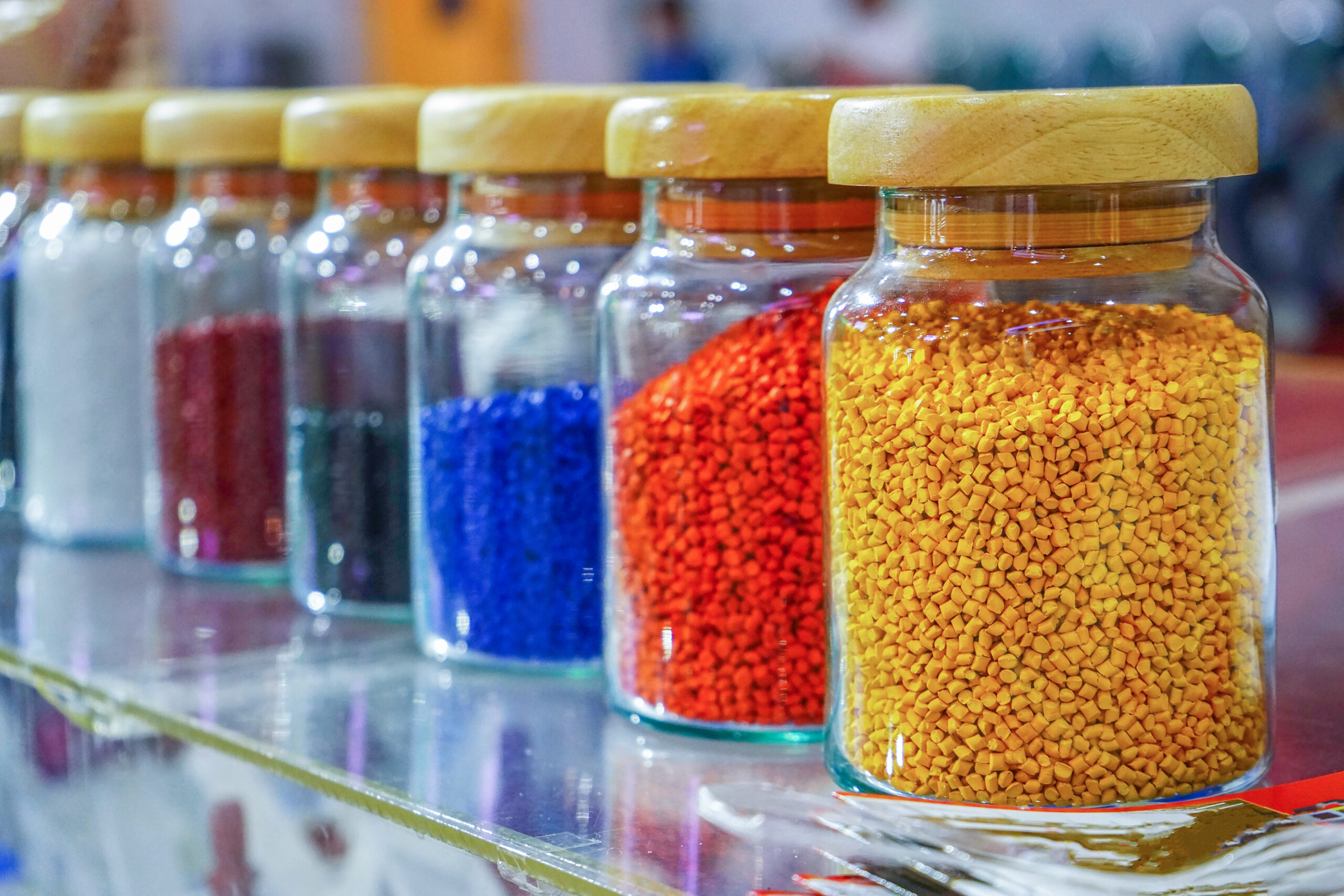
Color matching involves reproducing a specific color standard, such as a customer sample, Pantone reference, or digital specification, by blending colorants into a base polymer resin. The objective is to ensure that the final compounded material visually aligns with the target under defined lighting and viewing conditions. The deviation between the target and sample is calculated as ΔE. Lower ΔE values indicate closer matches. This requires controlling not only the pigment selection but also dispersion quality, processing conditions, and the optical properties of the polymer matrix.1 Color matching is essential across multiple industries including packaging for brand consistency, automotive for interior/exterior components, consumer goods for aesthetics and differentiation and medical devices to meet regulatory color standards. Examples of various color formulations of the same polymer can be seen in Figure 1.
Key Components of Color Matching
Base Polymer Influence
The natural color and optical properties of the base resin (e.g., polyethylene, polypropylene, ABS) significantly affect the final appearance. Natural polymers intrinsically may have slight yellow or gray tones that can shift final color. Transparent, translucent, and opaque polymers interact differently with light, influencing perceived color. Crystallinity of the base polymer can also influence the color. Semi-crystalline polymers (e.g., polypropylene) scatter light differently than amorphous polymers (e.g., polystyrene).
Pigments vs. Dyes
Pigments are insoluble particles that provide opacity, durability and thermal stability while Dyes are soluble colorants that offer transparency but lower thermal and UV stability. Pigments are typically preferred in compounding due to their stability during high-temperature processing. Pigments can be organic that provide high color strength and bright hues or inorganic providing superior thermal and UV stability.
Pigment Dispersion
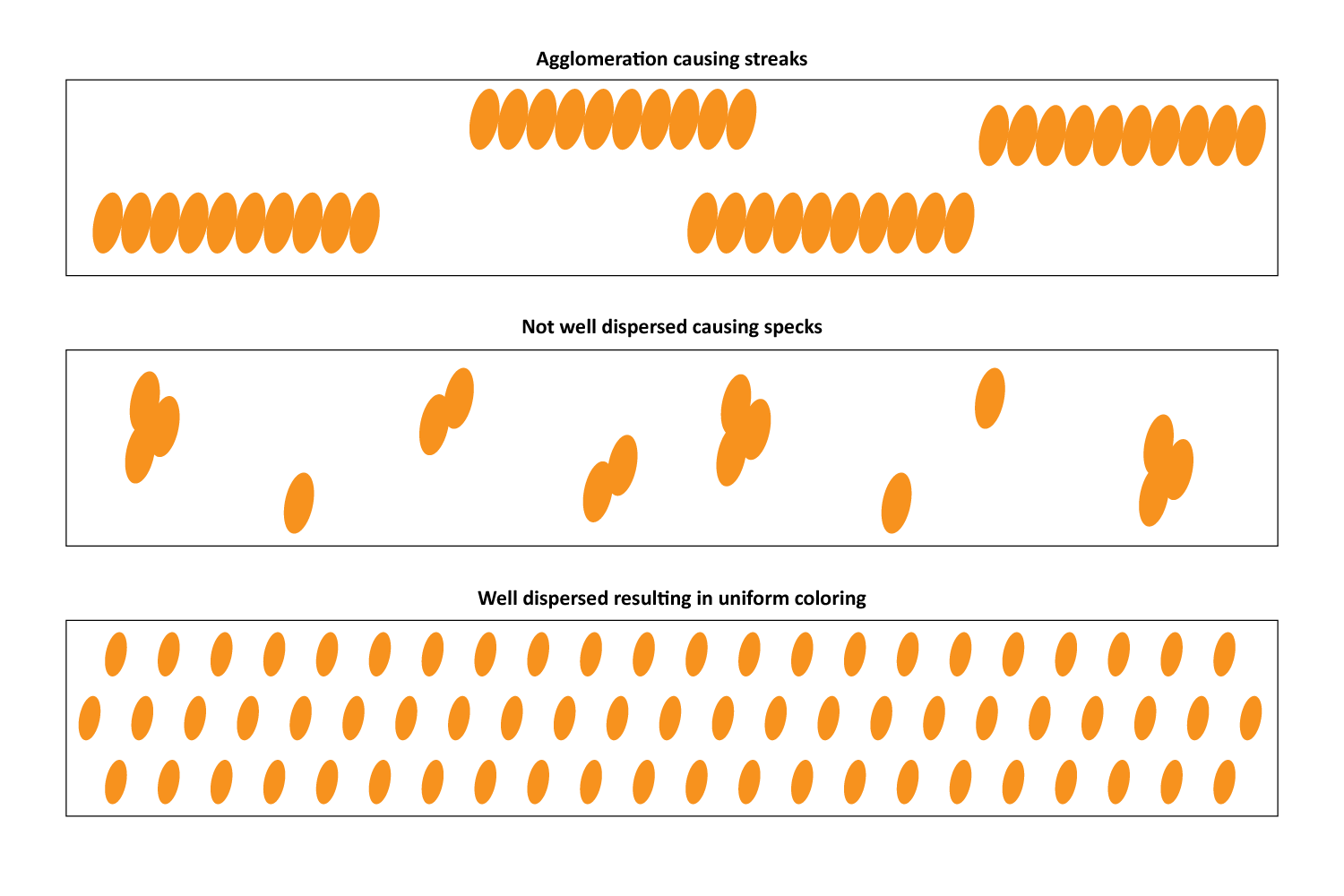
Dispersion determines how uniformly pigments are distributed within the polymer matrix (shown in Figure 2). Uniform dispersion ensures consistent light scattering and absorption while agglomeration causes streaking, specks, and inconsistent color. The level of dispersion is influenced by shear, mixing efficiency, and compatibility. Even with the correct formulation, poor dispersion will result in unacceptable color quality.
Masterbatches
Color is often introduced via masterbatches which are concentrated mixtures of pigments dispersed in a carrier resin. These allow precise dosing and consistent dispersion during compounding. The compatibility of masterbatch with carrier resin can affect dispersion and final appearance. The master batch to base polymer ratio also controls the color intensity.
Additives and Fillers
Additives such as UV stabilizers, antioxidants, or fillers can alter color by affecting light scattering, gloss, or surface finish. Fillers can increase opacity and light scattering while stabilizers may introduce slight color shifts. Additives must be accounted for during formulation to avoid unexpected color shifts.
What is Micro-Compounding?
Micro-compounding uses laboratory-scale extrusion systems, typically twin-screw extruders, to simulate full-scale polymer processing under controlled conditions. These systems replicate key parameters such as temperature, shear and residence time, while minimizing material consumption.
Micro-compounding enables color matching by allowing formulators to develop, test, and optimize color recipes using extremely small material quantities, usually few grams instead of kilograms. This approach is particularly valuable in R&D, custom color development, and cost-sensitive applications where rapid iteration and material efficiency are critical.
How Micro-Compounding Enables Color Matching
Rapid Formulation Iteration
Color matching is inherently iterative process.2 Micro-compounding allows multiple formulations to be tested quickly by adjusting pigment ratios in small batches. It enables the evaluation of several pigment combinations in parallel and quickly refine ΔE values to reach the desired target. This can reduce the development time from many days to few hours.
Minimal Material Consumption
Traditional compounding may require kilograms of resin and pigment for each trial. Micro-compounders reduce this requirement dramatically. Typically, micro-compounders use between 5 to 50 grams of materials per batch. This can lower the cost of materials, especially when using high-value engineering polymers, regulated materials, or expensive pigments. Reducing material consumption also reduces waste during the development process.
| Micro-compounding | Conventional Compounding | |
| Material Usage | Grams | Kilograms |
| Speed | Fast | Slow |
| Cost per trial | Low | High |
| Scale-up risk | Low | N/A |
| Flexibility | High | Limited |
Accurate Process Simulation
Micro-compounders are designed to mimic the thermal and shear conditions of production-scale extrusion. The screw speed, temperature profile, and residence time can be controlled resulting in comparable melt mixing dynamics with a production level compounder. This ensures that color results observed at the lab scale translate reliably to full-scale manufacturing.
Improved Pigment Dispersion Studies
Color consistency depends heavily on pigment dispersion. Micro-compounding enables detailed evaluation of dispersion quality. It identifies agglomerates or poor mixing and can optimize screw configuration and processing parameters to optimize pigment dispersion. This reduces defects such as streaking or color non-uniformity.
Efficient Masterbatch Development
Micro-compounding is widely used to develop and optimize masterbatch formulations before scaling up. It is used to determine optimal pigment loading levels, evaluate carrier resin compatibility and ensure reproducibility before production-scale extrusion. This reduces risk during scale-up and improves first-pass success rates.
Xplore Micro Compounders
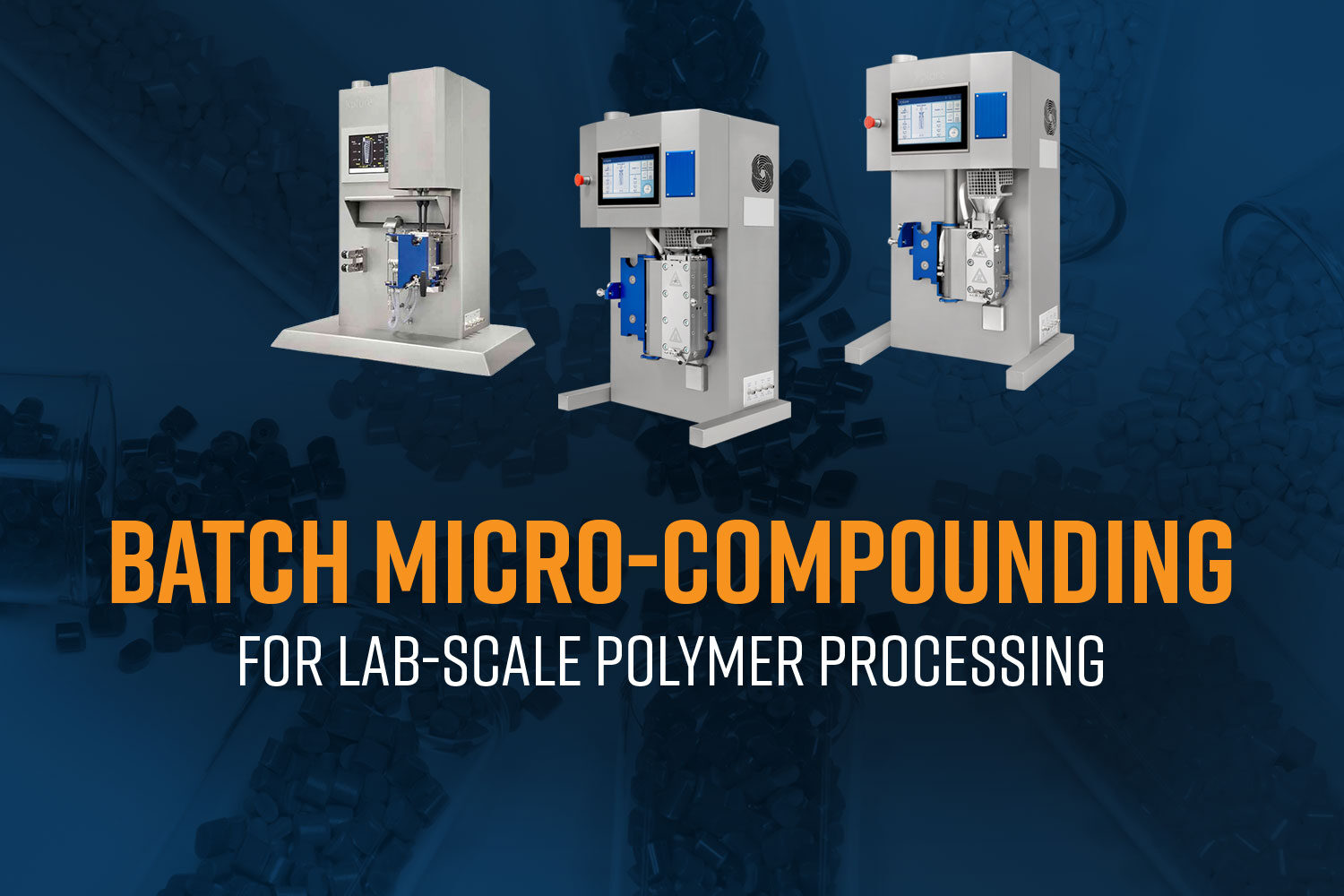
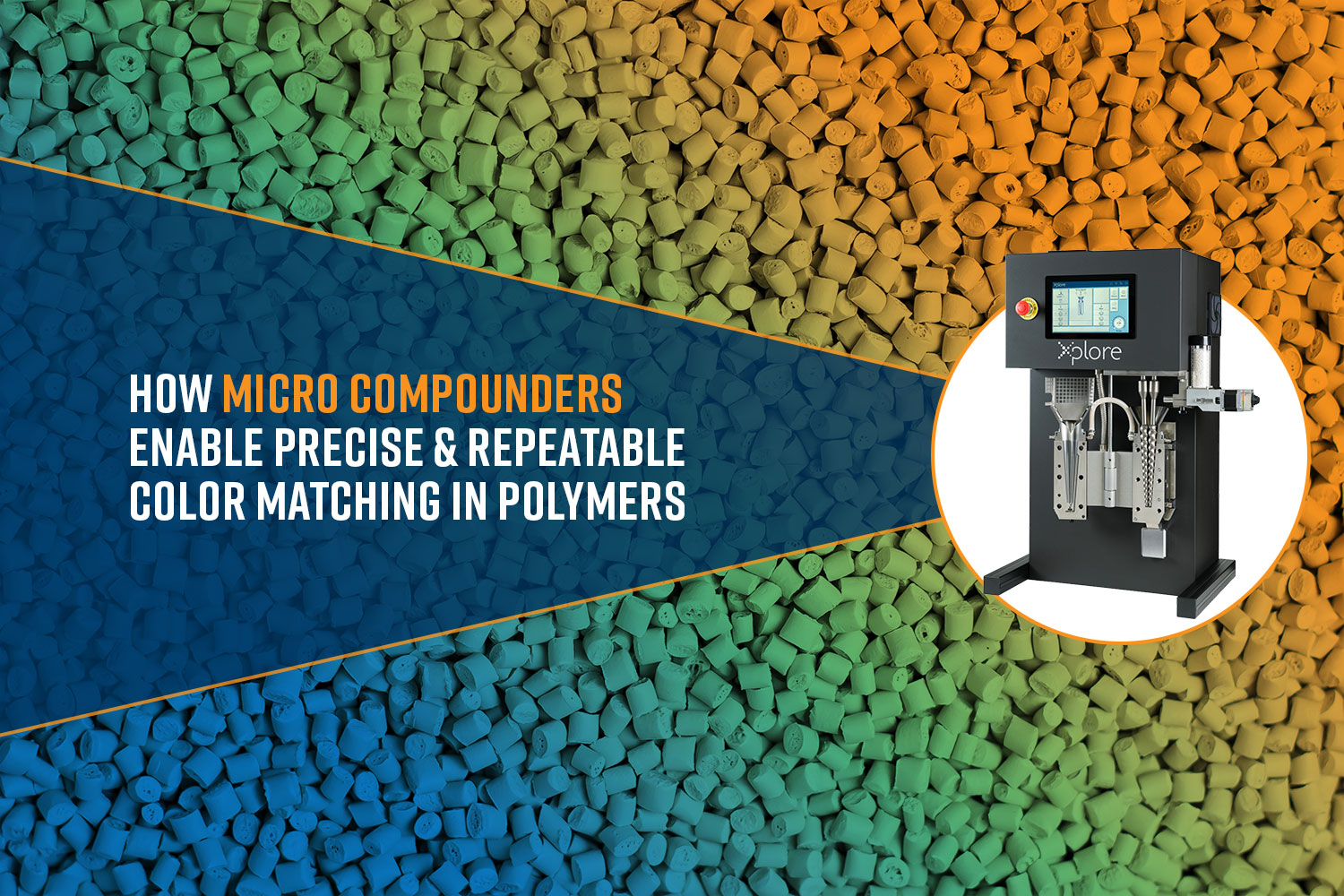
Xplore micro-compounders (Figure 3) are laboratory scale systems that enable highly controlled polymer processing using only a few grams of material. In color matching workflows, they provide a powerful platform for rapidly developing and optimizing pigment formulations while maintaining strong correlation to production-scale results.
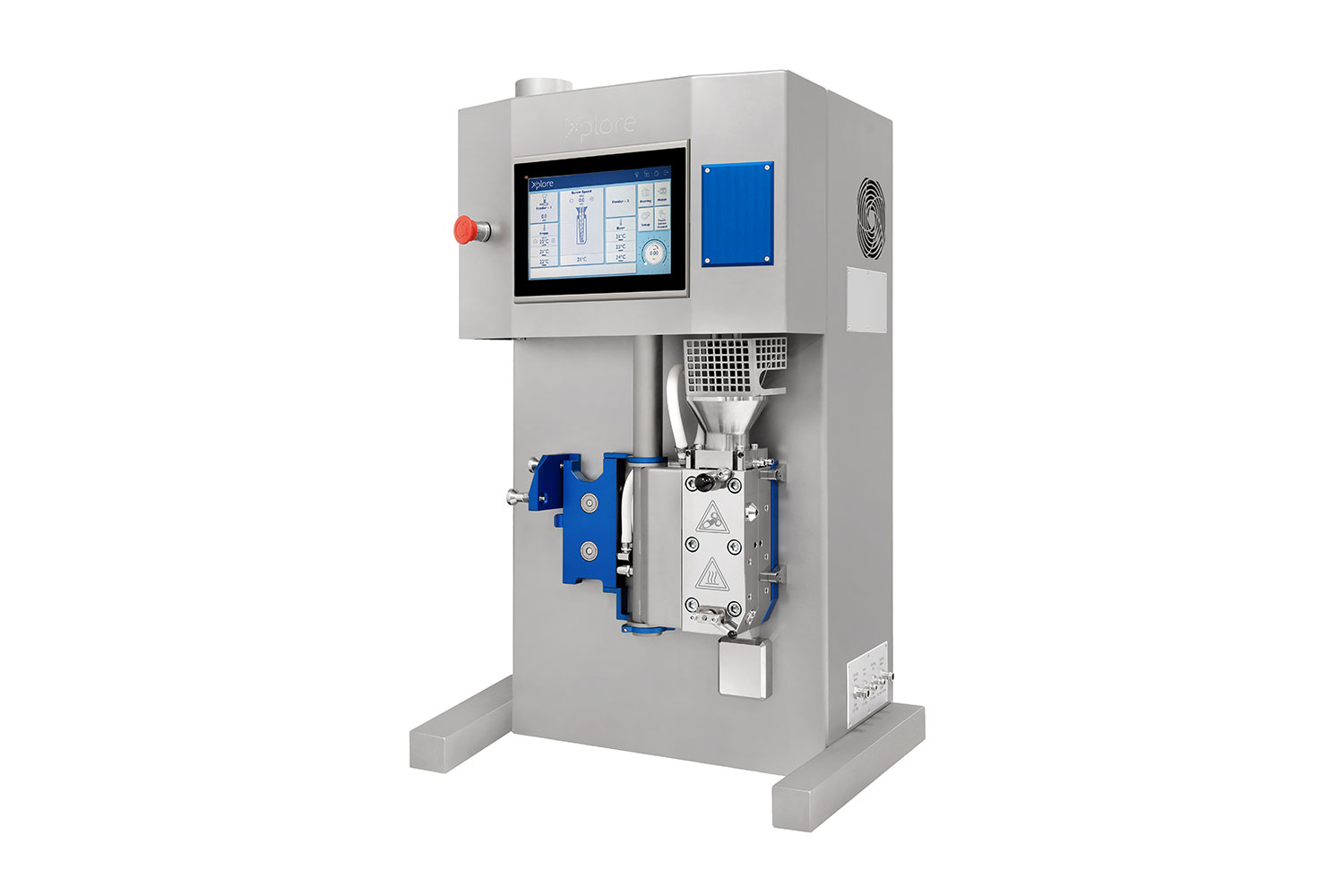
A key advantage of Xplore systems is their ability to replicate the thermal history, shear forces, and residence times typical of industrial twin-screw extrusion. This ensures that pigment dispersion, color development, and potential thermal degradation observed during lab trials closely reflect real production conditions. As a result, the risk of color shift during scale-up is minimized, improving first-pass success rates.
Uniform pigment dispersion is essential for achieving consistent color and avoiding defects such as streaking or speckling. Xplore micro-compounders provide controlled mixing environments that allow users to optimize screw configurations and processing parameters. This enables detailed study of dispersion quality and its direct impact on optical properties, supporting more robust color formulations.
Xplore micro-compounders are also widely used for developing and refining masterbatch formulations. Users can determine optimal pigment loadings, assess carrier resin compatibility, and validate processing stability before committing to large-scale production. This reduces material waste and ensures that final masterbatches deliver consistent color performance.
Summary
Color matching in polymer compounding is a controlled, data-driven process that combines material science, optics, and processing expertise. By carefully selecting pigments, accounting for polymer interactions, and using quantitative measurement tools, manufacturers can achieve precise and repeatable color performance across production batches. 3
Xplore micro-compounders are widely used in color matching applications due to their ability to deliver precise, repeatable compounding with minimal material consumption. These lab-scale twin-screw systems enable rapid screening of pigment formulations, allowing users to fine-tune color recipes and achieve target ΔE values using only gram-scale samples. By closely replicating the thermal and shear conditions of production extrusion, they ensure that pigment dispersion and color performance translate reliably to full-scale manufacturing. As a result, Xplore systems significantly accelerate color development cycles while reducing material costs and formulation risk.
Xplore micro-compounders play a critical role in modern color matching by combining material efficiency, precise process control, and rapid iteration capability. Their ability to simulate production conditions while enabling detailed dispersion and color analysis makes them an essential tool for accelerating formulation development, reducing costs, and ensuring reliable scale-up in polymer compounding.
References
- Neo, P. K.; Kitada, Y.; Deeying, J.; Thumsorn, S.; Soon, M. F.; Goh, Q. S.; Leong, Y. W.; Ito, H. Influence of Compounding Parameters on Color Space and Properties of Thermoplastics with Ultramarine Blue Pigment. Polymers 2023, 15 (24), 4718. https://doi.org/10.3390/polym15244718. ↩︎
- Alsadi, J.; Alawneh, A.; Khatatbeh, A. A.; Wahed, M. A.; Alseafan, M.; Alomari, S. Evaluating Processing Parameter Effects on Polymer Grades and Plastic Coloring: Insights from Experimental Design and Characterization Studies. Polymers 2024, 16 (23), 3409. https://doi.org/10.3390/polym16233409. ↩︎
- Plouzeau, M.; Piogé, S.; Peilleron, F.; Fontaine, L.; Pascual, S. Polymer/dye blends: Preparation and optical performance: A short review. Journal of Applied Polymer Science 2022, 139 (36). https://doi.org/10.1002/app.52861. ↩︎