Researchers studying interactions at surfaces and interfaces often need more than a simple yes-or-no answer about binding. They need to know how fast an interaction happens, how strongly molecules bind, how much material accumulates at the surface, and whether that surface layer changes thickness, density, or structure over time. Multi-Parametric Surface Plasmon Resonance, or MP-SPR, is designed for exactly this type of real-time, label-free surface analysis.

Surface Plasmon Resonance (SPR)
Surface Plasmon Resonance (SPR) is an optical sensing technique used to measure molecular interactions on the surface. Its ability to monitor binding in real time without labels makes it particularly valuable in life sciences and material sciences. Within life sciences, it is commonly applied to pharmaceutical research, biotechnology, biosensor development, and the study of biomolecular interactions.
SPR is an optical phenomenon that occurs when light interacts with a thin metal film, typically gold. When polarized light strikes the metal film at a specific angle, it excites surface plasmons at the metal–dielectric interface. The resulting surface plasmon is extremely sensitive to changes in the refractive index at the metal surface. When molecules bind to or dissociate from the sensor surface, the local refractive index changes. This produces a shift in the SPR response that can be monitored continuously and converted into a “sensorgram” that represents the interaction over time.1
One of the major advantages of SPR is that it provides information about both the thermodynamics and kinetics of molecular interactions. SPR can determine the equilibrium dissociation constant, KD, which describes how strongly two molecules interact. SPR can also determine the association rate constant, ka, and dissociation rate constant, kd. Together, these values show not only whether an interaction occurs, but how quickly it forms and how stable the resulting complex is.
The magnitude of the SPR response can also be related to the binding capacity and to the amount of material accumulating at the sensor surface. This makes SPR useful for quantitative interaction analysis.
Multi-Parametric SPR (MP-SPR)
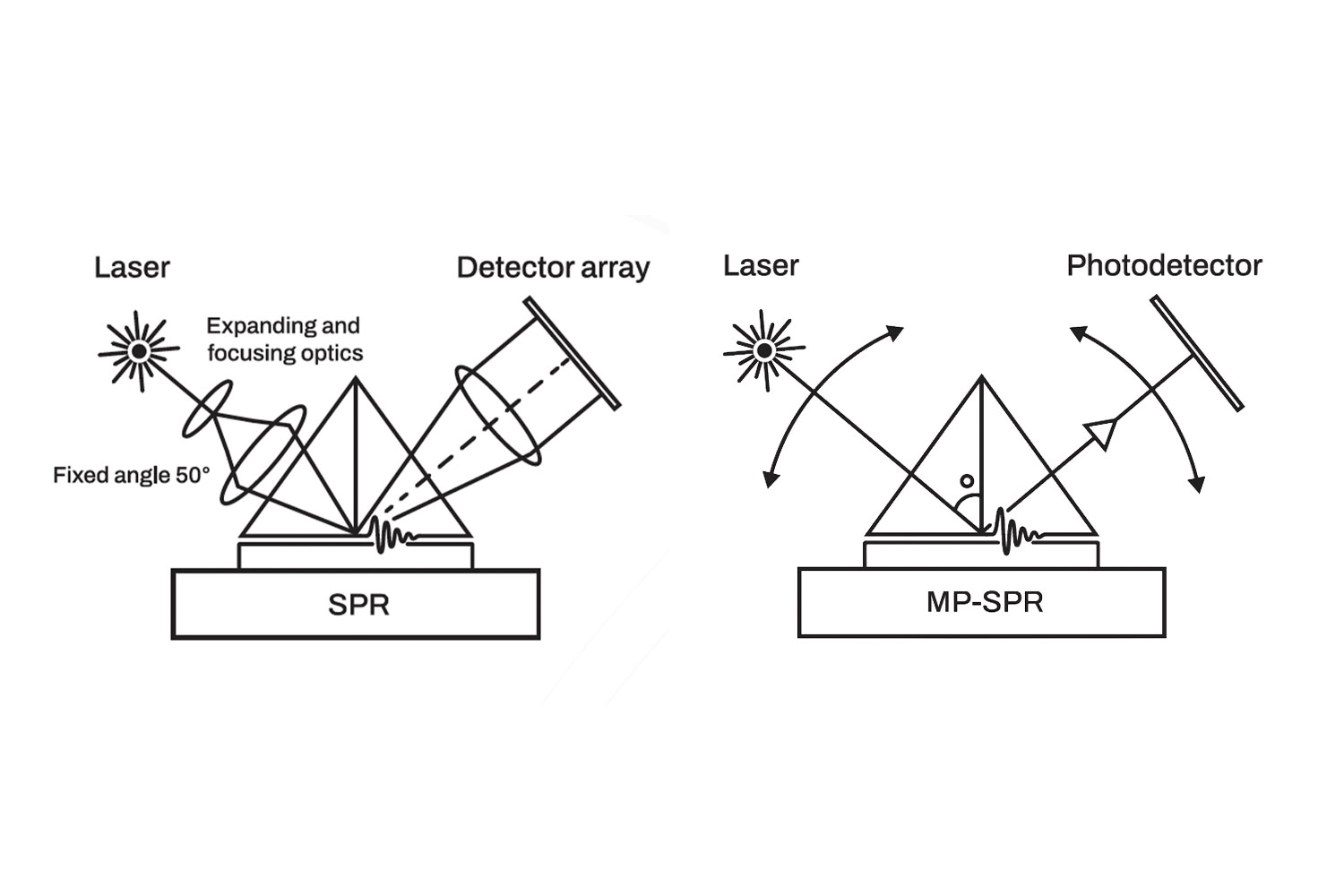
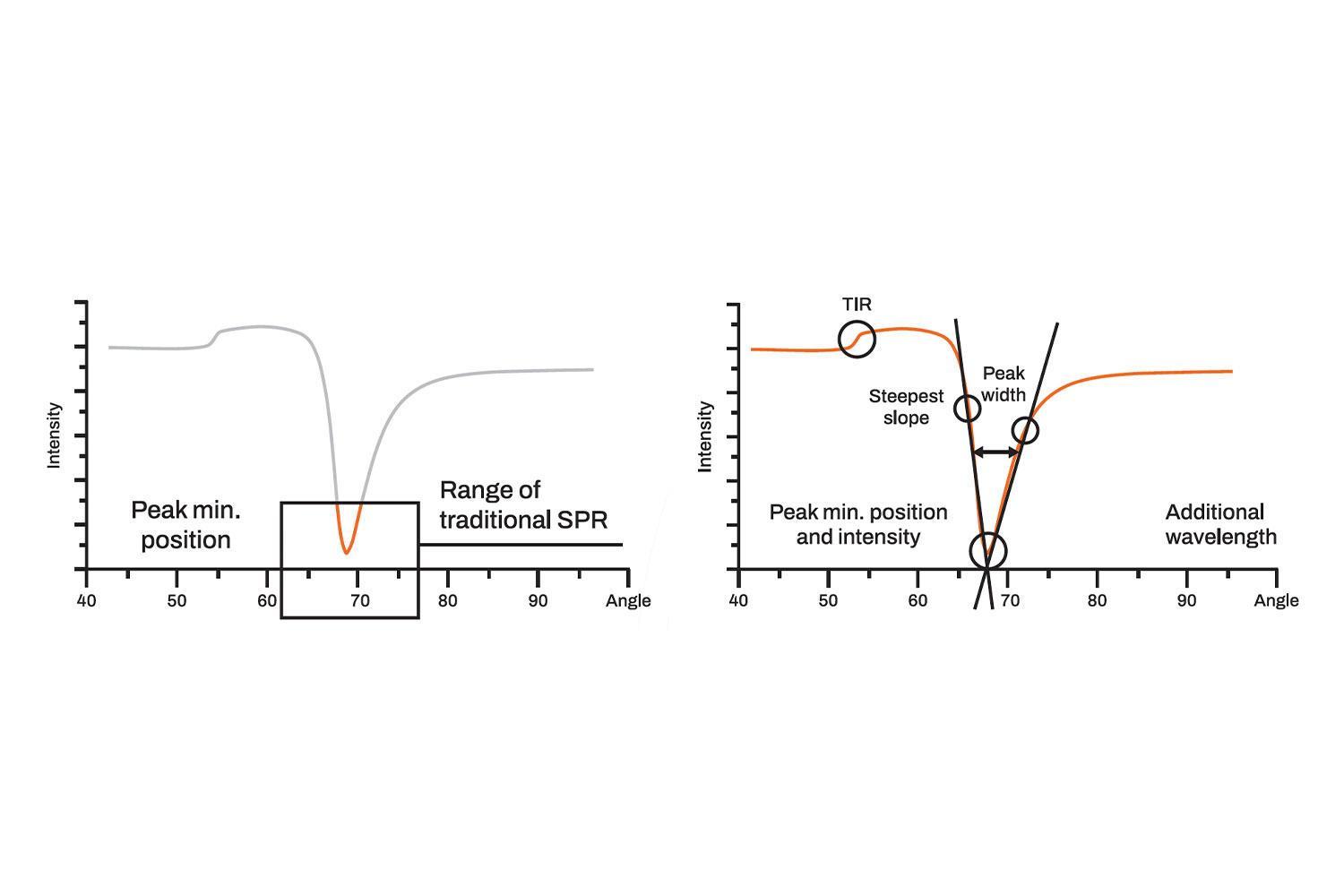
Multi-parametric surface plasmon resonance (MP-SPR) builds on the same fundamental SPR phenomenon but uses a broader optical measurement approach.2 Instead of measuring only near the resonance minimum, MP-SPR uses a goniometric optical setup to record the full SPR curve across a wide range of incident angles (figure 1). This complete curve supports more robust fitting, improves measurement accuracy, enables extraction of optical properties, supports characterization of multilayer structures, and improves performance with complex samples (figure 2). As a result, MP-SPR can measure molecular binding kinetics, surface mass changes, thin-film thickness, and optical constants of multilayer structures (refractive index and absorption coefficient).
In simple terms, conventional SPR is primarily optimized to measure biomolecular binding kinetics, while MP-SPR combines interaction analysis with quantitative characterization of surface layers. This means researchers can evaluate how much material binds to the surface, how thick a layer is, whether a film swells or contracts, and how its optical properties change during an interaction.
Unique Capabilities of MP-SPR
| Conventional SPR | MP-SPR |
| Real-time, label-free detection | Real-time, label-free detection |
| Measures changes at resonance peak minimum | Measures complete SPR curves |
| Optimized for biomolecular interactions | Molecular interactions + material characterization |
| Binding kinetics and affinity (ka, kd, KD) | Binding kinetics and affinity (ka, kd, KD) |
| Surface response | Surface response + layer properties |
| Single wavelength measurement | Multiple wavelengths |
| Limited structural information | Refractive index and layer thickness information |
| Primarily liquid-phase interaction analysis | Gas- and liquid-phase measurements |
The major advantage of MP-SPR is that it moves surface analysis beyond the simple question, “Did something bind?” It helps researchers ask a deeper question: “What happened at the surface, and how did the physical properties of that surface change over time?”
The broader angular range and multiple wavelengths used in MP-SPR help researchers separate parameters that are difficult to distinguish with conventional SPR. In thin-film characterization, for example, refractive index and thickness are closely linked. Conventional SPR often requires the refractive index to be assumed from literature, which can introduce uncertainty into calculated film thickness. MP-SPR can use measurements at multiple wavelengths to resolve both parameters more accurately.
MP-SPR can determine the refractive index of a layer rather than requiring that value to be assumed. This is valuable because the refractive index of a thin film can change with composition, hydration, deposition method, temperature, and environmental conditions. Because MP-SPR can also monitor thickness continuously, it can detect changes in film dimensions as they happen. For example, a polymer brush may expand or collapse in response to temperature, pH, ionic strength, or chemical binding.
The MP-SPR can quantify properties of thin surface layers, including film thickness, refractive index, surface coverage, and adsorption kinetics. It can determine the thickness of nanoscale films and coatings, from films only a few Ångström thick to structures in the micrometer range, depending on the optical configuration and sample. These capabilities make MP-SPR useful for characterizing polymer layers, lipid membranes, self-assembled monolayers, polyelectrolyte multilayers, hydrogels, and functional coatings.
MP-SPR can measure the kinetics of material accumulating on or leaving the surface. This is useful for studying adsorption of proteins, polymers, nanoparticles, surfactants, and other materials. Combining kinetic information with thickness and refractive-index measurements provides a more complete picture of what is occurring at the interface. A change in signal can potentially be separated into contributions from material binding, changes in film thickness, swelling, or changes in optical properties.
Conclusion
SPR and MP-SPR are both powerful, label-free techniques for studying molecular interactions in real time. Conventional SPR excels at measuring binding affinity and kinetic parameters such as KD, ka, and kd. MP-SPR extends that capability by measuring complete SPR curves across a broad angular range and at multiple wavelengths, enabling researchers to characterize not only molecular interactions but also thin-film thickness, refractive index, adsorption, desorption, swelling, surface coverage, and structural changes.
These enhanced capabilities make MP-SPR a versatile platform for researchers working with thin films, polymers, coatings, biomembranes, nanoparticles, drug-delivery systems, antibody development, biosensors, and complex biointerfaces. For applications where the surface itself is changing, MP-SPR provides a more complete view of the interaction by connecting molecular binding with the physical behavior of the interface.
References
- Jodaylami, M. H.; Masson, J.-F.; Badia, A. Surface Plasmon Resonance Sensing. Nature Reviews Methods Primers 2025, 5 (1). https://doi.org/10.1038/s43586-025-00417-8. ↩︎
- Kari, O. K.; Tatu Rojalin; Stefano Salmaso; Michela Barattin; Jarva, H.; Meri, S.; Marjo Yliperttula; Tapani Viitala; Arto Urtti. Multi-Parametric Surface Plasmon Resonance Platform for Studying Liposome-Serum Interactions and Protein Corona Formation. Drug Delivery and Translational Research 2016, 7 (2), 228–240. https://doi.org/10.1007/s13346-016-0320-0. ↩︎