Surface free energy (SFE) is a quantitative measure of the intermolecular forces at a solid surface. It dictates how a solid behaves when in contact with a liquid. It is an important parameter for applications relating to adhesion, bonding, adsorption, and interfacial intermolecular forces.1 Because SFE cannot be measured directly, accurately determining a material’s SFE is nontrivial. In this article, we discuss how to most accurately characterize a material’s SFE using a variety of test liquids.

What is Surface Free Energy?
Surface free energy is a measure of how readily a material’s surface interacts with other materials, such as liquids, adhesives, or coatings. It determines how easily a surface can be wetted, coated, printed, or bonded. Materials with high surface free energy, such as clean metals and glass, attract liquids. As a result, water spreads across the surface, allowing paints, inks, and adhesives to adhere more effectively. In contrast, materials with low surface free energy, such as Teflon and polyethylene, repel liquids. Water forms droplets instead of spreading, making these surfaces much more difficult to coat or bond without surface treatment.
At the atomic level, surface free energy exists because atoms at the surface have fewer neighboring atoms than those inside the material. This creates an imbalance in the forces acting on the surface atoms, giving them more energy than atoms in the bulk material. This excess energy determines how strongly a surface interacts with other substances. Surface free energy is an important property in many applications, including painting, printing, packaging, medical devices, electronics, and manufacturing, where reliable wetting and adhesion are essential.
How is Surface Free Energy determined?
SFE cannot be directly measured but can be indirectly determined. The simplest way to determine SFE is with static contact angle measured with an optical tensiometer. Different mathematical models have related a solid’s SFE with the contact angle of a pure liquid. The most widely used SFE model is the Owen, Wendt, Rabel, and Kaelble (OWRK) method, which divides surface energy into contributions from dispersive interactions (γdsv) and polar interactions (γpsv), with the total SFE being the sum of the two components (γsv=γdsv + γpsv).2
Contact angle data can be used to determine the two SFE components using the OWRK equation:
√ |
γdsvγdlv |
+ |
√ |
γpsvγplv |
= |
0.5γlv (1 + cosθ) |
||
Equation 1: where γdlv is the liquid’s dispersive surface tension component, γplv is the liquid’s polar surface tension component, γlv is the liquid’s total surface tension, and θ is the measured contact angle of the liquid on the solid surface.
where γdlv is the liquid’s dispersive surface tension component, 𝛾plv is the liquid’s polar surface tension component,γlv is the liquid’s total surface tension, and 𝜃 is the measured contact angle of the liquid on the solid surface. By rearranging the OWRK equation, the SFE can be expressed as linear equation in the form of γ=mx+b:
γlv (1 + cosθ) |
= |
√
|
√γpsv |
+ |
√γdsv |
||||||||||
2√γdlv |
|||||||||||||||
Equation 2.
The contact angle measured for the different test liquids can then be graphed with Equation 3 as the y-axis and Equation 4 as the x-axis, as shown in Figure 1. Since a minimum of 2 data points are required for linear regression analysis, contact angle must be measured with at least two different liquids with known surface tension components.
γlv (1 + cosθ) |
||||
2√γdlv |
Equation 3.
√
|
Equation 4.
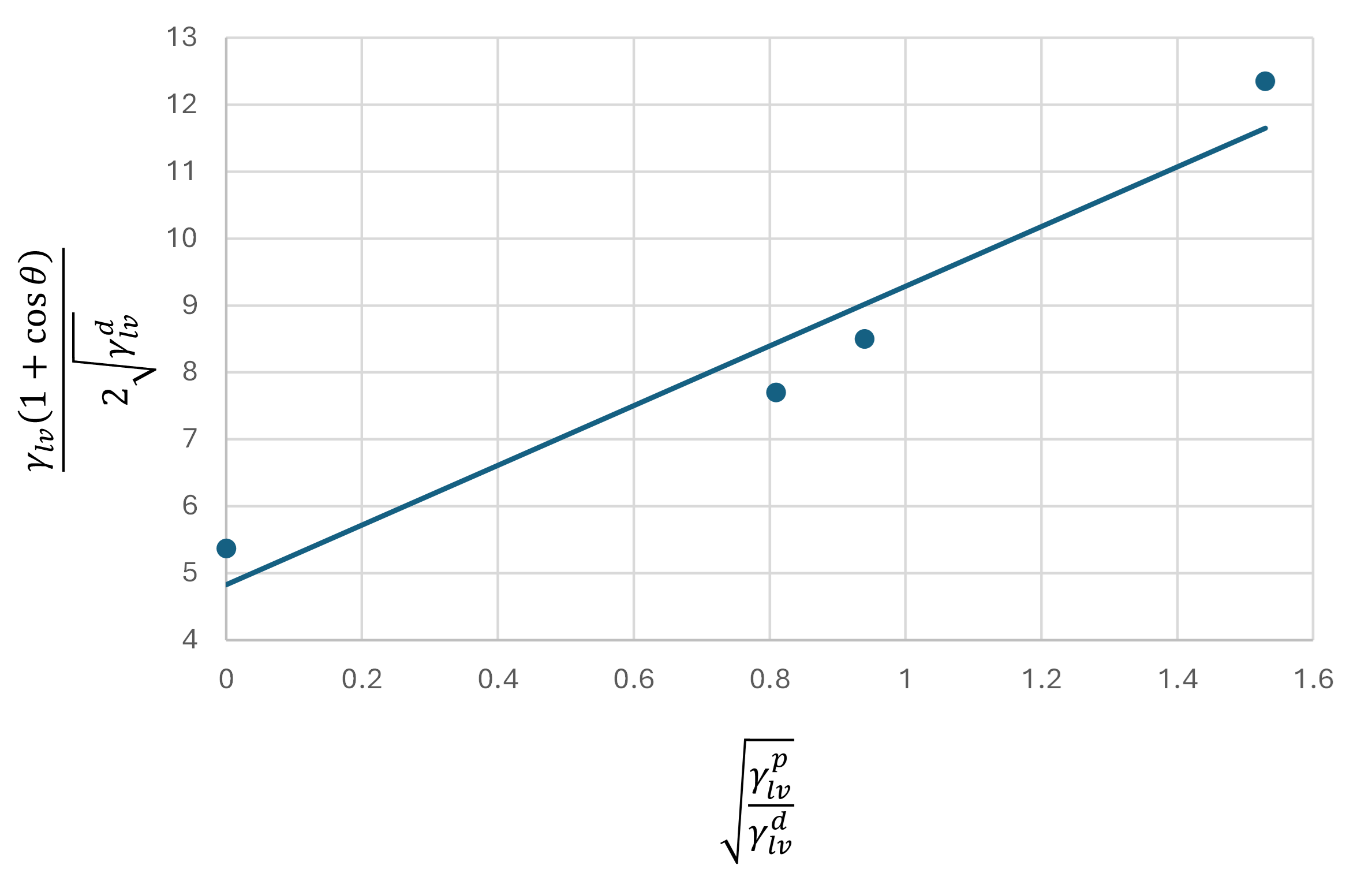
The SFE components are determined from the regression line as follows:
Polar SFE component: γpsv = (slope)2
Dispersive SFE component: γdsv = (y intercept)2
Experimental Determination of SFE
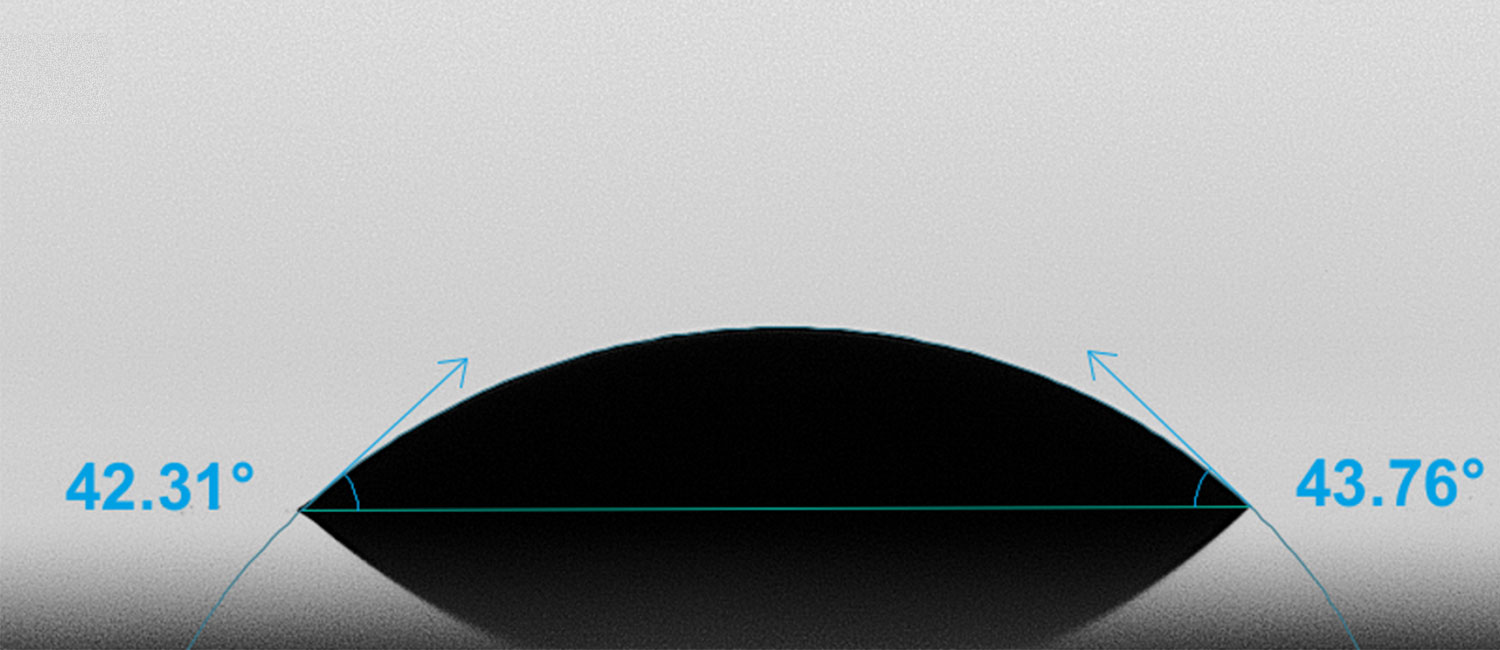
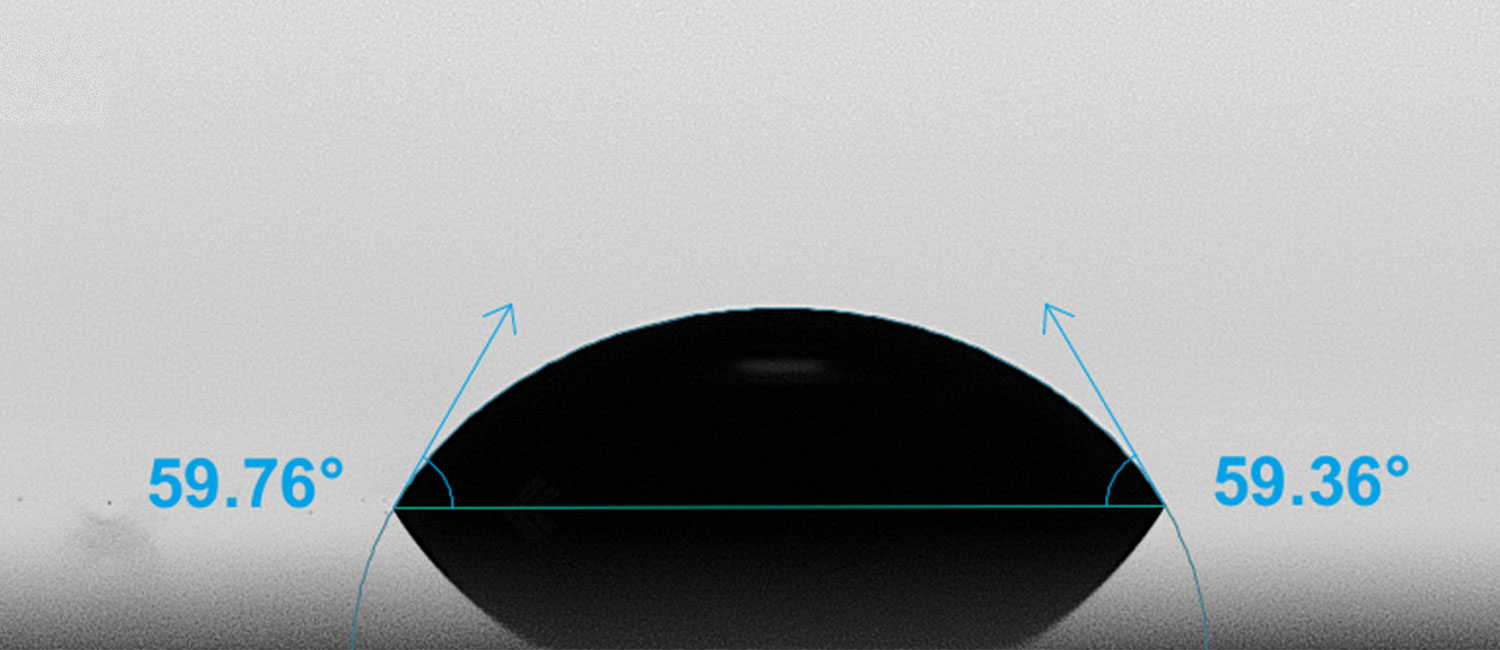
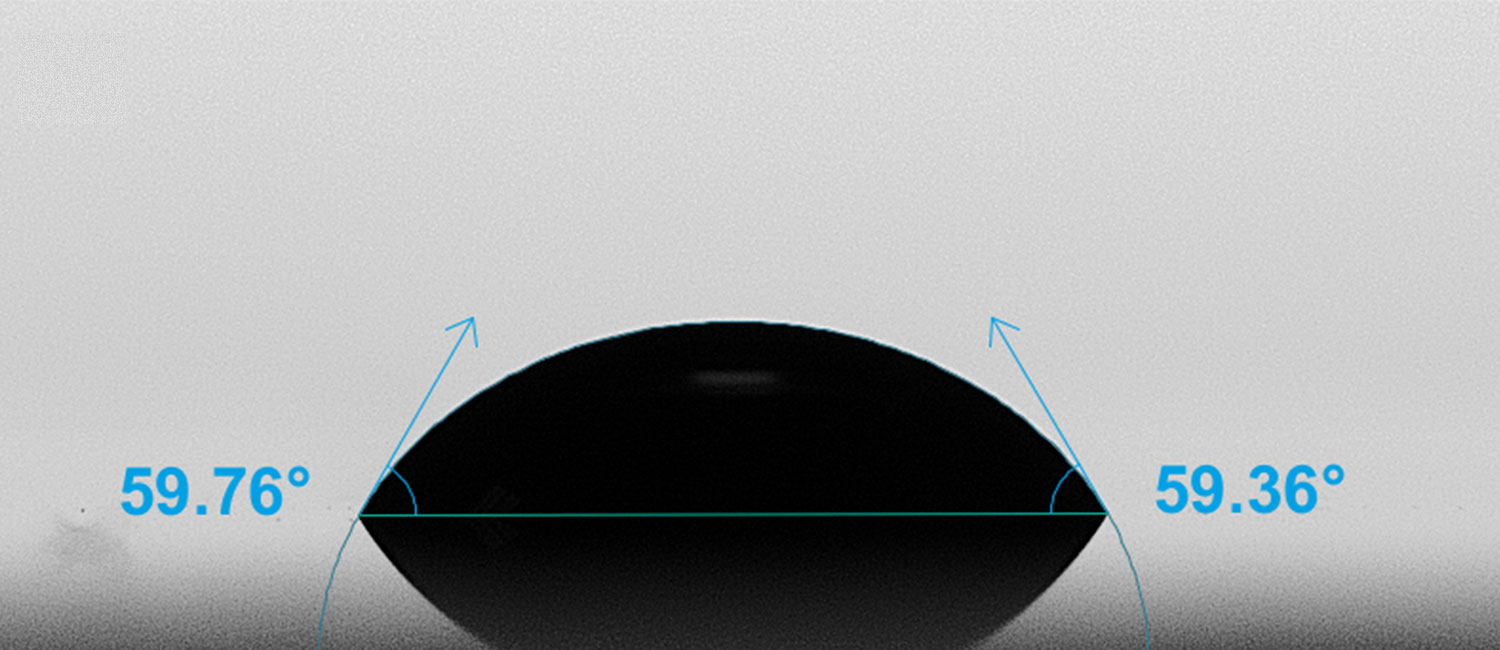
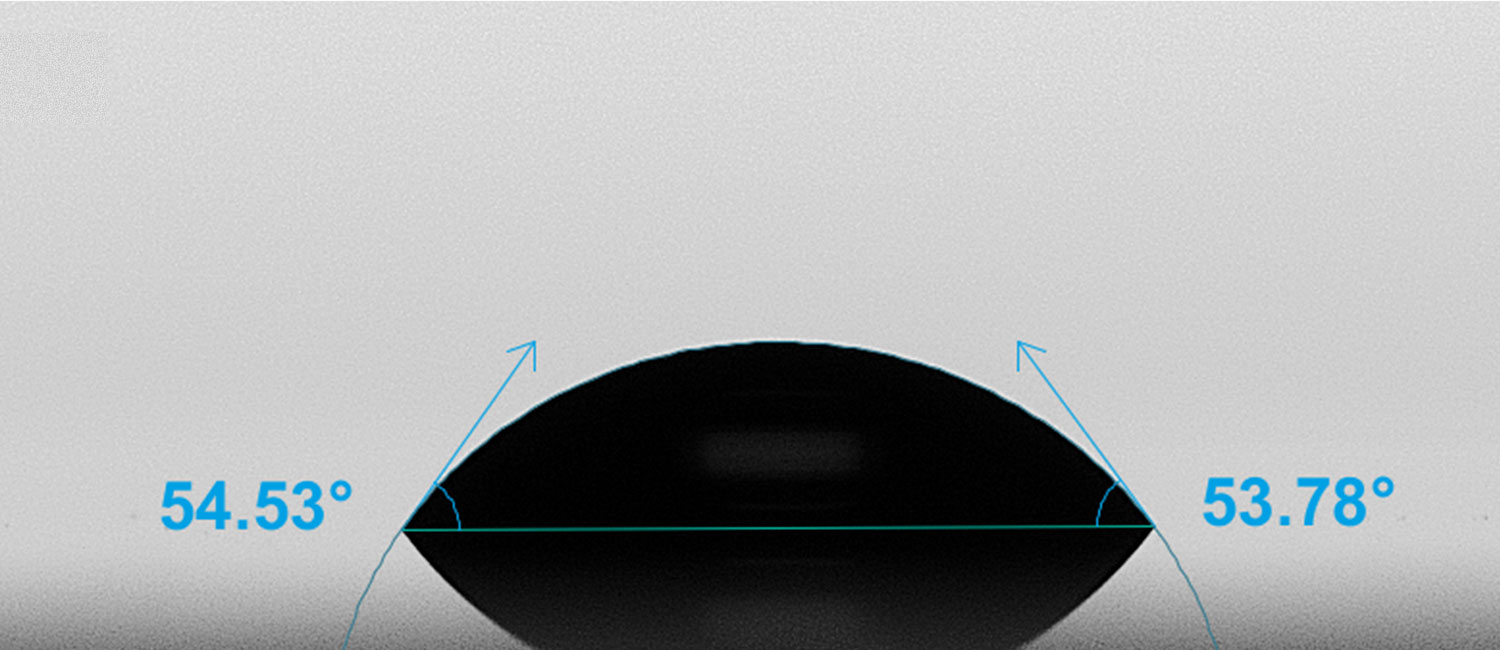
To best characterize the two SFE components, contact angles are measured using a dispersive liquid and a polar liquid with known surface tension components. Polar liquids typically contain heteroatoms like nitrogen and oxygen that make them capable of polar interactions with the surface. Water, ethylene glycol, glycerol, and formamide are common polar liquids used for SFE measurements. Dispersive liquids are nonpolar liquids with high enough surface tension to produce a measurable contact angle on the surface. Because most nonpolar liquids have low surface tension, more exotic nonpolar liquids with high surface tension like diiodomethane and α-bromonaphthalene are needed to have a non-zero contact angle for most materials. Figure 2 shows an example of contact angle measured with a polar and dispersive liquid on the same material surface.
Improving precision of Surface Free Energy determination.
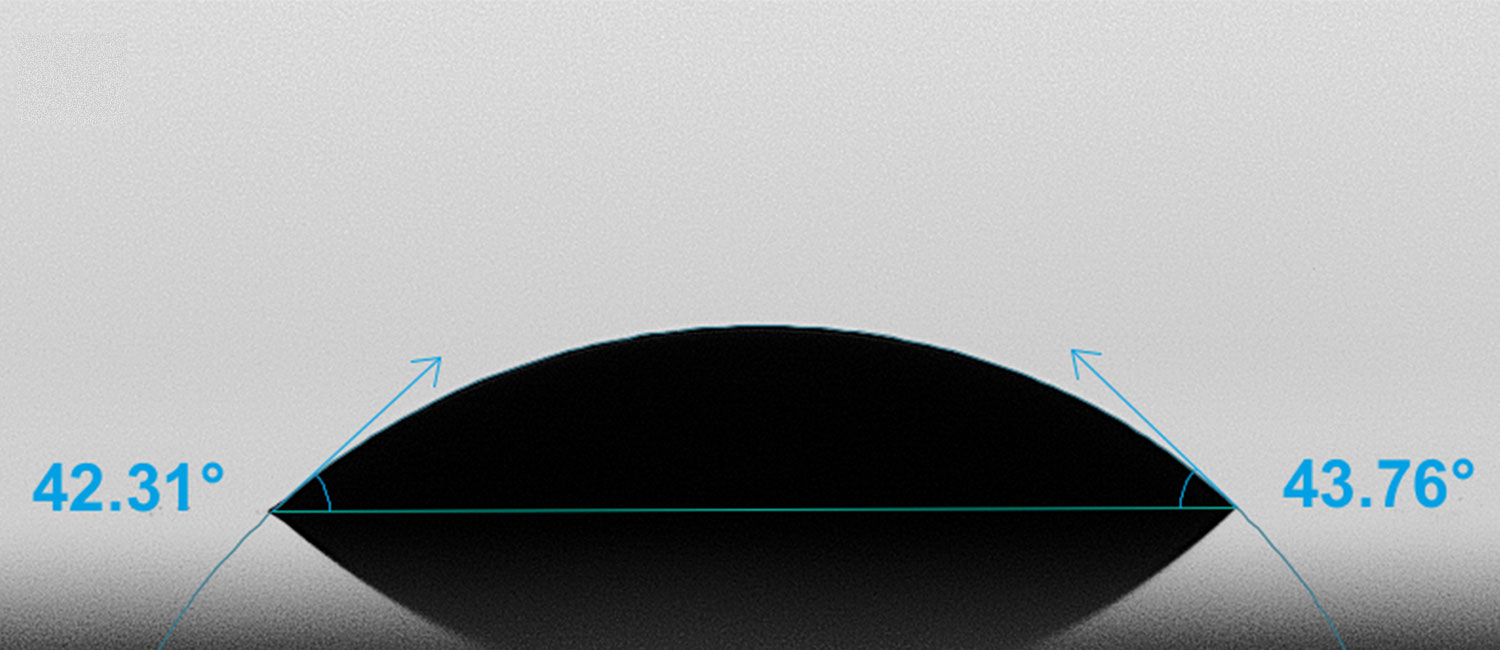
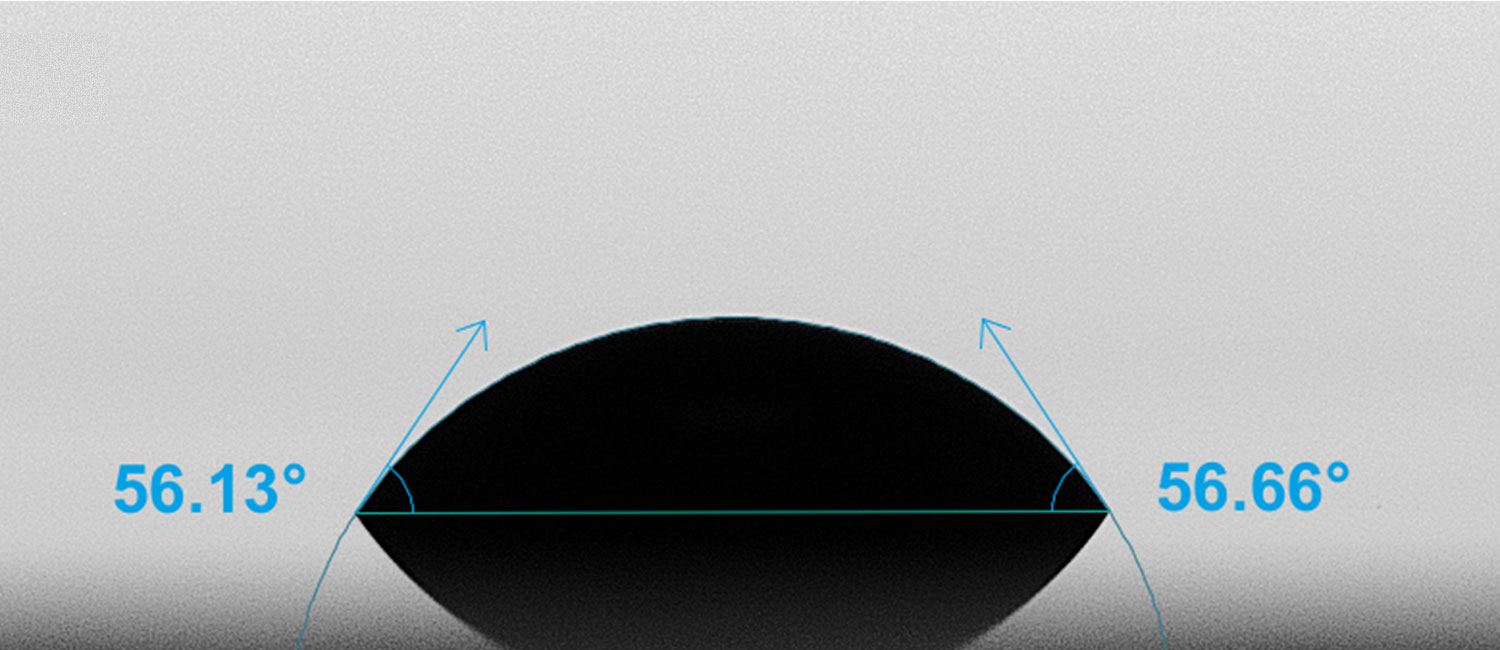
While a regression line used to determine SFE, in theory could be made with contact angle data of just two test liquids, it would not give any information about the accuracy of the determined SFE and may be subject to random errors. Data from more than two liquids can be fit to the linearized OWRK equation to give a more precise SFE than could be determined with only two liquids.1 By measuring contact angle of more liquids with a variety of dispersive and polar properties, the dispersive and polar SFE components can be better characterized. Figure 3 shows an example of contact angle measured on the same material tested with four different liquids.
Using more test liquids obviously comes with the trade-off of being more time intensive. However, modern optical tensiometers can simplify this process with automated dispensing of multiple test liquids. Software can also automatically determine SFE using the linearized OWRK approach to quickly determine SFE for any number of test liquids.
Attension Theta
The Attension line of optical tensiometers is designed to provide fast, accurate, and automated surface free energy (SFE) measurements through precise contact angle measurement. Because determining surface free energy requires measurements with multiple probe liquids, Attension systems are equipped with multi-liquid dispensers that automatically dispense each liquid without manual intervention. The automated dispenser can dispense up to four different liquids using disposable pipette tips. Disposable dispensing tips prevent cross-contamination between liquids, ensuring highly repeatable contact angle data and improving the accuracy of surface free energy calculations.
Combined with the advanced OneAttension software, SFE can be determined automatically using a variety of test liquids. By automating the dispensing process, contact angle measurement and SFE determination, Attension optical tensiometers increase throughput, reduce measurement variability, and simplify surface characterization for applications in materials research, quality control, coatings, polymers, medical devices, and semiconductor manufacturing.
Conclusion
Surface free energy is a critical property that influences wetting, adhesion, coating performance, and overall material functionality. Accurate surface free energy determination begins with reliable contact angle measurements using multiple probe liquids, making precision and repeatability essential. The Attension line of optical tensiometers simplifies this process with automated liquid dispensing, disposable tips that eliminate cross-contamination, and advanced software for fast, consistent data analysis. Whether used in research, product development, or quality control, Attension instruments provide the accuracy and efficiency needed to confidently characterize material surfaces. By streamlining surface characterization, Attension optical tensiometers help scientists and engineers make informed decisions that lead to improved product performance and more reliable manufacturing processes.
References
- Zhang, Z.; Wang, W.; Korpacz, A. N.; Dufour, C. R.; Weiland, Z. J.; Lambert, C. R.; Timko, M. T. Binary Liquid Mixture Contact-Angle Measurements for Precise Estimation of Surface Free Energy. Langmuir 2019, 35 (38), 12317–12325. https://doi.org/10.1021/acs.langmuir.9b01252. ↩︎
- Owens, D. K.; Wendt, R. C. Estimation of the Surface Free Energy of Polymers. Journal of Applied Polymer Science 1969, 13 (8), 1741–1747. https://doi.org/10.1002/app.1969.070130815. ↩︎